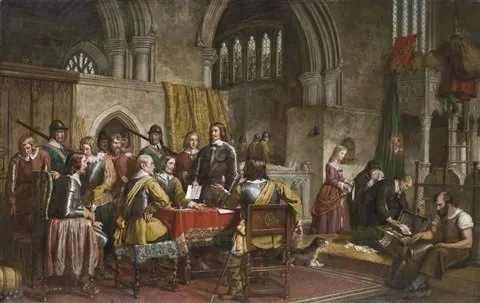
Considerable time seems to have been spent in conference between the commissioners appointed by Colonel Salusbury and General Mytton, to negotiate the capitulation of the castle to the parliamentarians. The fortress was not delivered up to parliament until the 26th October 1646, when the royalist garrison marched out with drums beating and colors flying.
It would appear that it took a whole month upon receiving the royal warrant to surrender the castle to the parliamentarians before the articles of capitulation where finally agreed upon. On the 14th October 1646, an agreement was made between Lieutenant Colonel Mason, Lieutenant Colonel Twisleton, Captain Robert Farrar, Simon Thellwall, Rodger Hanmer, Thomas Edwards and Nathaniel Barnett all of whom had been appointed by General Mytton and Lieutenant Colonel Griffith, Colonel Wynne, Lieutenant Major Manley, Major Reynolds, John Eaton, John Thellwall and Henrik Eaton all of whom where appointed by Colonel Salusbury. Local tradition relates that as soon as the articles of surrender were signed, Colonel Salusbury mounted Goblin Tower, and threw down the keys to the castle, making use of a rather course welsh expression, signifying “the world is yours, make it your dunghouse!”.
The evacuation of Denbigh castle must have presented one of the most interesting and moving scenes that can be imagined. The veteran soldiers that had garrisoned the citadel for the past six months, making their semi-triumphal exit the the beat of drums being followed by the vast multitude of civilians from all walks of life that had found shelter behind the castle walls. For days after the surrender, the streets and highways leading in every direction from Denbigh would have been traversed by departing pedestrians and equestrians with carts, wagons and every description of vehicle and conveyance of the period setting out for every part of Wales, England and the European continent.