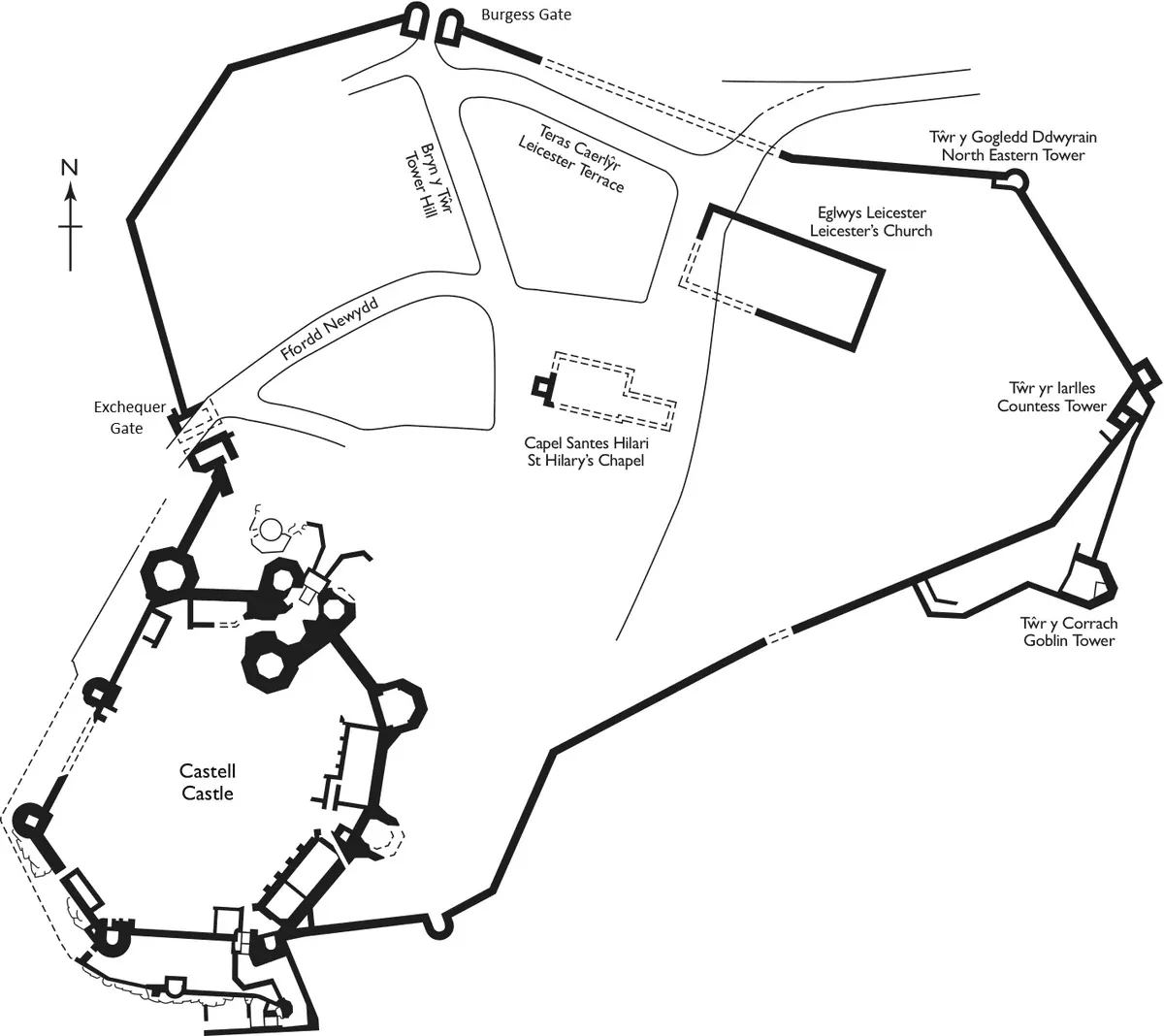
The town walls were the first work undertaken by Henry de Lacy at Denbigh after the town’s capture from the Welsh in 1282. Much of the Town Wall still remains today. There are three impressive towers that are still extant, all of which where built in the fourteenth century: the Burgess Gate, which formed the main entrance into the town, the Countess Tower and the Goblin Tower. There was a second gate known as the Exchequer Gate, however this entrance way has now been almost totally destroyed.
The line of the walls that was chosen was dictated by the need to place the walls a close as possible to the cliff edge, though the rock face may have been made more severe both by quarrying to obtain stone for the walls and by later quarrying for building material when the town moved outside the walls. The town was originally laid out in 1290 with 47 burgage plots, all occupied or rented and an attempt was made to apply a regular street plan. However, the inconvenience of a hill-top site and the cramped space for market activities meant that late in the fifteenth century, the town spread onto the flatter ground around the present market place.
In 1586 a visitor to Denbigh, William Camden observed: ‘The old town is now deserted and a new one, much larger, sprung up at the foot of the hill which is now so populous that the church not being large enough for the inhabitants, they have now begun to build a new one where the old town stood.’ By the time of the Civil War only a few houses remained within the walls and this area was regarded as the outer ward of the castle.