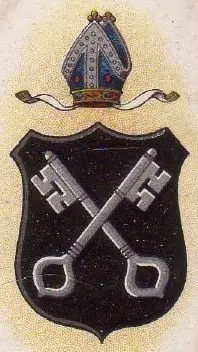
Robert Parfew
Robert Parfew (c1490 – 1557, also known as ‘Robert Warton’) was an English Benedictine abbot. He was elected as the bishop of St Asaph in 1563 and later in 1554 was appointed as the Bishop of Hereford. As a contemporary at the time of the dissolution of the monasteries, Parfew received the surrender of the Carmelites of Denbigh Friary and was a key figure in reforming establishing Ecclesia Anglicana, the Anglican church.
It is not known when Robert Parfew was born, although it is highly likely that he was probably born in the latter years of the fifteenth century. He was a Cluniac (Benedictine) monk, and was appointed as abbot of Bermondsey Abbey. On 8 June 1536 he was elected bishop of St. Asaph, but retained the abbacy of Bermondsey in commendam until 1538, when the abbey was suppressed under King Henry IIIV reforms, from which Parfew received a substantial pension.
Parfew resided mostly at Denbigh. In 1537 he was one of 46 divines and bishops headed by Thomas Cranmer drawing up of The Institution of a Christian Man. The purpose of the work; along with the Ten Articles (the first guidelines of the Church of England as it became independent of Rome) which were produced in the previous year in 1536; was to implement the reforms of Henry VIII in separating England and Wales from the Roman Catholic Church. On 18 August 1538 he received the surrender of the Carmelites of Denbigh Friary.
Parfew was present at some of the most notable events at the court of Henry IIIV. In 1537 he was present at the christening of Prince Edward and he was also present at the funeral of Jane Seymour; in 1538 he was at the reception of Anne of Cleves, and subsequently he signed the declaration that would annul the marriage between King Henry and Anne. In 1551 he became a member on the council for Wales. At the beginning of Queen Mary's reign he was retained and was made a member of the commission which expelled the majority of the bishops. On the 1st March 1554 translated to the diocese of Hereford in place of John Harley, who had been deprived due to his Protestantism and possibly because he was married. Parfew is recorded to have died on 22nd September 1557.