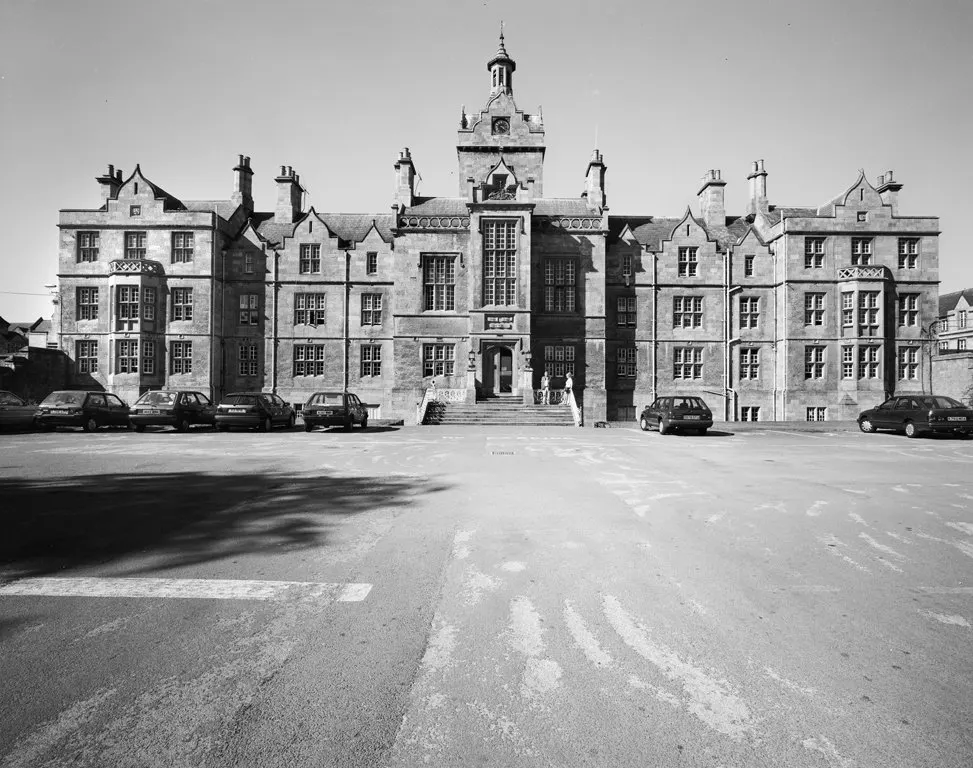
Built from 1844-47 and opening to patients during 1848 in response to concerns for Welsh only speaking patients having to be treated in English hospitals as Wales didn’t have the facilities to accommodate them. A purpose built Victorian Asylum with additions and detached buildings. It was one of the most sophisticated and pioneering of the early Victorian asylums.
Formally known from its conception as the North Wales Counties Lunatic Asylum, this complex of buildings is the most important purpose-built mental hospital within Wales and ranks as one of the most sophisticated and pioneering of the early Victorian asylums in Britain. Plans for the asylum were first discussed in 1842, three years before the Lunacy Act of 1845 made the provision of such buildings mandatory at county level. In March 1843 the Committee for Management instructed Thomas Fulljames (of Fulljames and Waller, architects of Gloucester) to produce plans for an asylum for 200 patients. The building was constructed between 1846 and 1848 at a final cost of £63,906 15s 4 and a-half pence (£63,906.77p); the contractor is recorded as a Mr Hawke. The cost of building such an institute in agricultural North Wales was too prohibitive for one County alone to shoulder and so through collaboration with neighboring Counties and affluent businessmen and landowners the creation of the ‘North Wales Counties of Caernarvonshire, Denbighshire, Flintshire, Merionethshire and Anglesey Asylum’ which provided the communities of North Wales the care they needed. The thirteen acre plot of land was donated by Joseph Ablet Esq and the money raised by public subscription. It was stressed on opening in December 1848, that the asylum was intended 'not only for the reception of the pauper lunatics of the counties in union, but also for the admission of a limited number of patients of the middle and upper ranks of society'.
During its long and noteworthy life many different practices were used here, such as Insulin Shock Treatment, Electro-Convulsive Treatment (ECT) and Pre-frontal Leucotomies or Lobotomies as they’re better known. The hospital was gradually closed down over a number of years and eventually put up for sale. Some interest in the property was displayed during 1996 which came to nothing.
In 2001 thieves stripped the building of many of its original features which have ended up in architectural salvage yards before being sold off and lost forever. It was at this time that the clock above the main entrance was removed. The buildings today stand empty and are suffering from neglect. Recently Denbighshire County Council has agreed to Compulsory Purchase the building in order to halt its decline and hopefully open it up to re-development again.