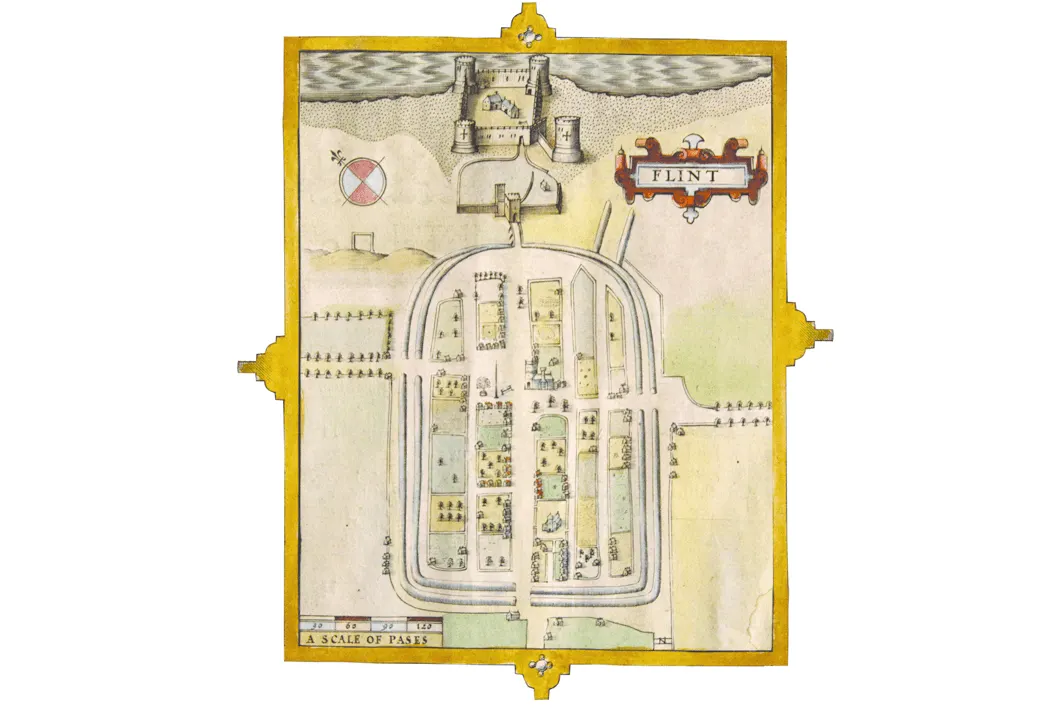
Flint town was built at the same time as the castle but life was not easy for its early English residents.
Inland from the castle, the new town was built on a regular grid pattern, modelled on the bastide towns of France. There were six parallel streets running north-south and one cross-route. The castle, the market square (the area around the present Town Hall) and the church all lay in a direct line along the main thoroughfare (what is now Church Street and Castle Street). Remnants of this grid pattern still remain today.
Living in Edward I’s ‘new town’ was not an easy option. The castle defences were formidable with high stone walls and a double moat, but the town had to rely on a deep ditch between earthen banks and so was more vulnerable.
The new town was populated with English settlers who had been given the opportunity to purchase a plot in the town. The local Welsh were excluded, not allowed to carry weapons, hold assemblies or purchase property or land within the borough. Living in the turbulent borderlands evidently held little appeal as take up of tenancies was slow. In 1282, in an attempt to attract more people, plots were rented out free of charge for 10 years and at reduced rent thereafter. By 1290, there were 78-80 householders. All but five were English and racial tensions remained high for centuries.
The town was attacked and burned several times. In 1282 it survived an onslaught by supporters of Llywelyn and Dafydd ap Gruffydd but some houses were burned. 12 years later it faced another Welsh attack led by Madog ap Llywelyn in response to unfair laws and taxes. This time the Constable of the castle himself ordered the burning of the town to protect the castle from attack. Over 70 buildings were destroyed, leaving little unscathed.
In 1400 Flint was hit again during the revolt of Owain Glyndwr whose supporters returned to besiege the castle in 1403. Once again, the castle provided a place of refuge for the townspeople, who it was said, ‘dared not linger outside the castle’. On that occasion, the town escaped destruction but was slow to recover from the upheaval.