Leeswood – The Great Oil Rush
The use of Oil Shale Fracking to recover energy reserves is the latest way the energy giants are attempting to meet the increasing demand for oil and natural gas for the domestic market. This method of exploiting fossil fuel deposits is a controversial subject and it is worth remembering that the early development of Leeswood depended on its natural deposits of fossil fuels.
Hydrofracking or the hydraulic fracturing of fossil seams is used to release the oil and gas deposits contained within. The energy from the injection of a highly-pressurised fracking fluid creates new channels in the rock which can increase the extraction rates and ultimate recovery of fossil fuels. These channels are kept open by injecting a fluid containing grains of sand or ceramic. The controversial nature of this process is that it can induce small earthquakes and contaminate underground water sources. The major advantage of this method of recovering natural energy is that it does not involve men working underground.
Leeswood has played its part in providing energy in the past by mining coal at great cost to human health and life. There are approximately 150 mine shafts and adits recorded in the Leeswood area and no doubt there are many more unrecorded. Leeswood has also played its part in the safer working in mines and the improvement in the social welfare of mine workers no doubt triggered by the Mold (Leeswood) Riots.
One of the most significant deposits in this area is Cannel Coal. The following tonnages of Cannel coal were raised in the area over a period of 3 years:
1862 28,816 tons
1864 120,000 tons
1865 150,000 tons
This data is from the records of Leeswood Hill, Leeswood Green, Coed Talwrn, Copa and Nerquis collieries. In the lead up to this period the population of the area increased by approximately 50%.
What prompted this sudden change? Oil.
Oil has been used for centuries for light and heat and around this time the major source had been whales which were fished almost to extinction. Whales were like modern oil tankers roaming the oceans of the world.
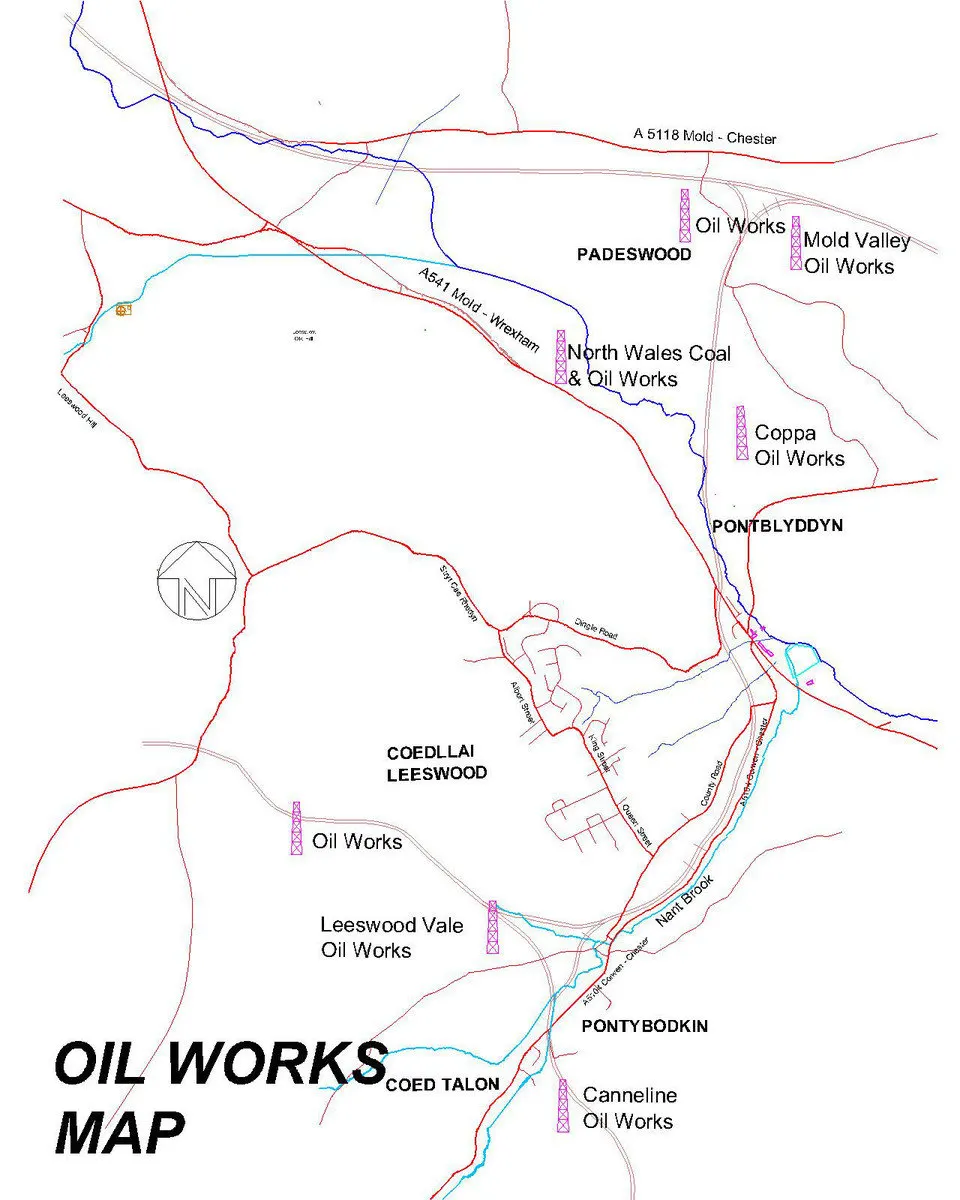
On October 17, 1850, James Young, of Glasgow, patented a method for the extraction of paraffin (kerosene presently used in central heating boilers) from cannel coal. In 1847 Young had his attention called to a natural oil in the Riddings colliery at Alfreton, Derbyshire from which he distilled a light thin oil suitable for use as lamp oil, at the same time obtaining a thicker oil suitable for lubricating machinery. By 1860/70 there were approximately 25 companies in the Leeswood area refining cannel coal, many in a crude form to be further refined at Saltney, Queensferry or Bagillt.
Cannel coal comes in three varieties:
Type Yield Price
Curley 80 £1-40p
Smooth 35 45p
Shale 33 43p
Some seams were too thin to work. Seams with a thickness of 120cm were worked at Leeswood Green 85 metres deep and 150cm thick and 150 metres deep at Leeswood Colliery. Hitting the right type of coal in a workable thickness and convenient depth was clearly critical and you have to admire the courage of the miners risking life and livelihood in these speculative ventures.
Cannel coal is a light bituminous coal which does not soil the fingers. The term is supposed to be a corruption of "candle coal" because it burns without smoke. It is exceptionally hard and was used as a floor in Lichfield Cathedral.
The oil boom was short lived, the LEESWOOD MAIN COAL CANNEL and OIL COMPANY (Limited) was wound up on the 16th March 1867. Cheaper sources of oil as in the Texas oil fields put an end to it. No doubt there are still large quantities left below ground in the Leeswood area. It seems unlikely that it would be suitable for fracking because of its strength and non-laminar structure.