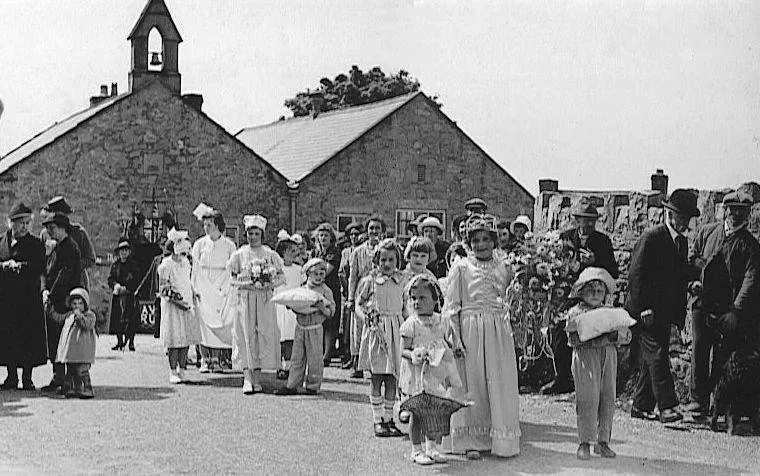
Ysceifiog today is a peaceful village that lies off the beaten track, but it had a long and fascinating history. The now quiet lanes were once important trade and transport routes, and, for centuries, the village was a bustling place, with numerous pubs and shops.
The settlement has ancient roots. Finds of Stone Age flint tools, Bronze Age burial mounds, a gold torc (a neck band), the nearby Iron Age hill forts, Romano-British brooches, the possible remains of a Dark Age dyke and several medieval houses bear testament to its long history.
Ysceifiog’s location on the border of England and Wales meant it was disputed territory for many centuries and has seen much unrest. It was one of the few places in Wales mentioned in the Domesday survey in 1086, recorded as Schiviau, as it was under Norman control and was part of the ancient cantref of Teigeingl that was annexed to Cheshire.
By Tudor times, the area was more stable and prosperous. Ysceifiog lay on an important pack-horse route between Chester and Denbigh and long trains of pack-horses would have passed frequently through the village. In the 17th century this route became part of the London to Holyhead Post Road and the village would have been a welcome stopping point for travellers.
Farming has always been the main land use although, in the 18th-20th century, the nearby lead mines on Halkyn Mountain provided work for many local men and others worked in the small local quarries.
Nowadays sheep and cattle still graze the fields but no industries remain and the main transport routes bypass the village. Walkers, naturalists and fishermen, coming to enjoy the natural beauty and tranquillity, have replaced the travellers and tradesmen stopping for refreshment.