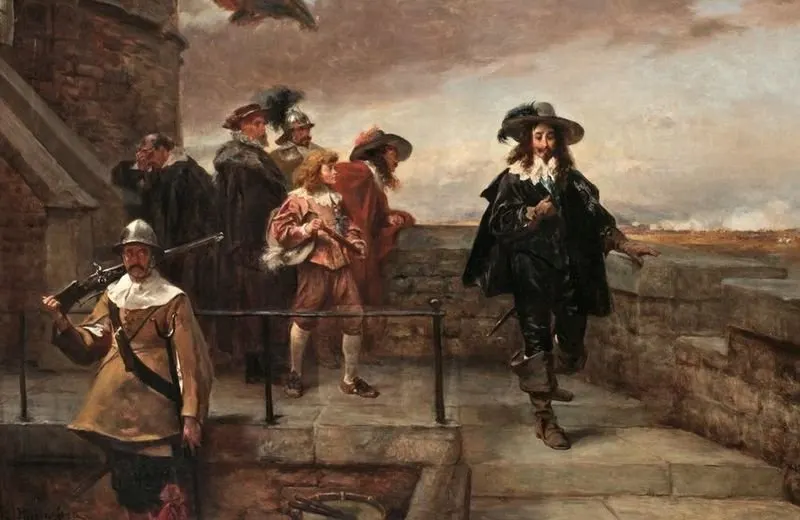
On the 24th September 1645, King Charles I witnessed the total defeat of his forces at the Battle of Rowton Heath, Cheshire. In the aftermath of the royalist defeat, the king was compelled to retreat to North Wales and seek protection at Denbigh Castle which was under the governorship of William Salusbury of Rhug.
By September 1645 things were going extremely bad for the royalist cause. Three months prior, Charles' main army was decimated during the Battle of Naseby (14th June 1645) and the subsequent royalist defeats at the Battle of Marston Moor (2nd July 1645) and Battle of Langport (10th July 1645) significantly weakened the royalists.
Watching from the top of the Phoenix Tower, Chester, Charles witnessed the total defeat of his forces on the battlefield of Rowton Heath. The royalist casualties of the battle has been estimated at over 600 dead and 900 injured with Parliamentarian losses, although unknown, must also have significantly high. Following the defeat, King Charles withdrew from Chester the next day with his remaining forces and retreated into North Wales to Denbigh Castle.
During his stay at Denbigh Castle, the king resided in the tower apartments known then as the "Great Kitchen" but which would subsequently be known as the "Kings Chamber" or "King Charles' Tower". It is recorded that Colonel William Salusbury, who had been appointed governor of Denbigh Castle spent time with King Charles and that “he spoke plainly to his majesty for two hours in private”, What had passed between the king and Salusbury, will never be known, what is recorded is that we cannot precisely tell, however it is recorded that King Charles himself is supposed to have remarked “Never did a prince hear so much truth at once”.
On the 27th September 1645 there was a general rendezvous at the parish church of Cyffylliog in which the king himself was supposed to have been present. The following day the king left Denbigh Castle for Chirk Castle to meet with Prince Maurice of the Palatinate. From Chirk Castle the king would travel through Montgomeryshire to Bridgenorth, then to Newark and finally would set out for Scotland.