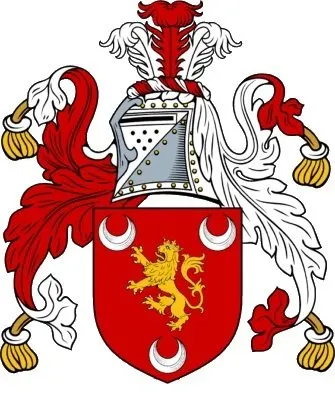
William Salesbury (1580–1660) also known in later years as ‘Hen Hosanau Gleision – Old Blue Stockings' was a Welsh privateer in the East Indies, poet and MP for Merioneth (1621 to 1622). He was also the royalist Governor of Denbigh and held Denbigh Castle over a siege lasting six months until the final days of the English Civil War and only surrendered on the written instruction of Charles I.
William was born in 1580 in a house near the town of Denbigh. He was the son of John Salusbury and Eisabeth Salusbury and the brother of Sir Robert Salesbury who would become MP for Denbighshire. The Salusbury family motto was “A vynno Dew dervid - What God wills will come to pass”.
It is recorded that in his youth William served on board the sailing vessel, the Barque Wylloby in the East Indies. On 19 October 1599, William enrolled at Oriel College, Oxford. In 1611, the family estates were passed to William following the death of his uncle. On the 10th December 1611, it was arranged that William would marry Dorothy Vaughan, eldest daughter of Owen Vaughan of Lloydiarth.
In 1643, a year after the start of the Civil War, William fortified Denbigh Castle out of his own money. As a staunch Royalist, he supported Charles I, became a colonel in the Royalist army during the Civil War and was appointed governor of Denbigh Castle, which he repaired at his own expense. With a garrison of 500 men, the castle was virtually impregnable without a large attacking army. When the castle came under siege from parliamentary forces in 1646, William held out for six months and refused to surrender on five occasions. Finally, on 26 October 1646, William agreed to surrender to General Mytton, but only after receiving a letter from the king instructing him to agree terms.
On the eve of the King's execution in 1649, Charles sent William an embroidered cap of crimson silk as a token of his respect. For the duration of The Protectorate, William was heavily fined for his commitment and loyalty to the Royalist cause. Upon the restoration of Charles II, in 1660, William was nominated for the order of Knight of the Royal Oak, having an estate of £800 a year. William died at the age of 80 years in 1660 and was buried at Llanynys, near Denbigh.