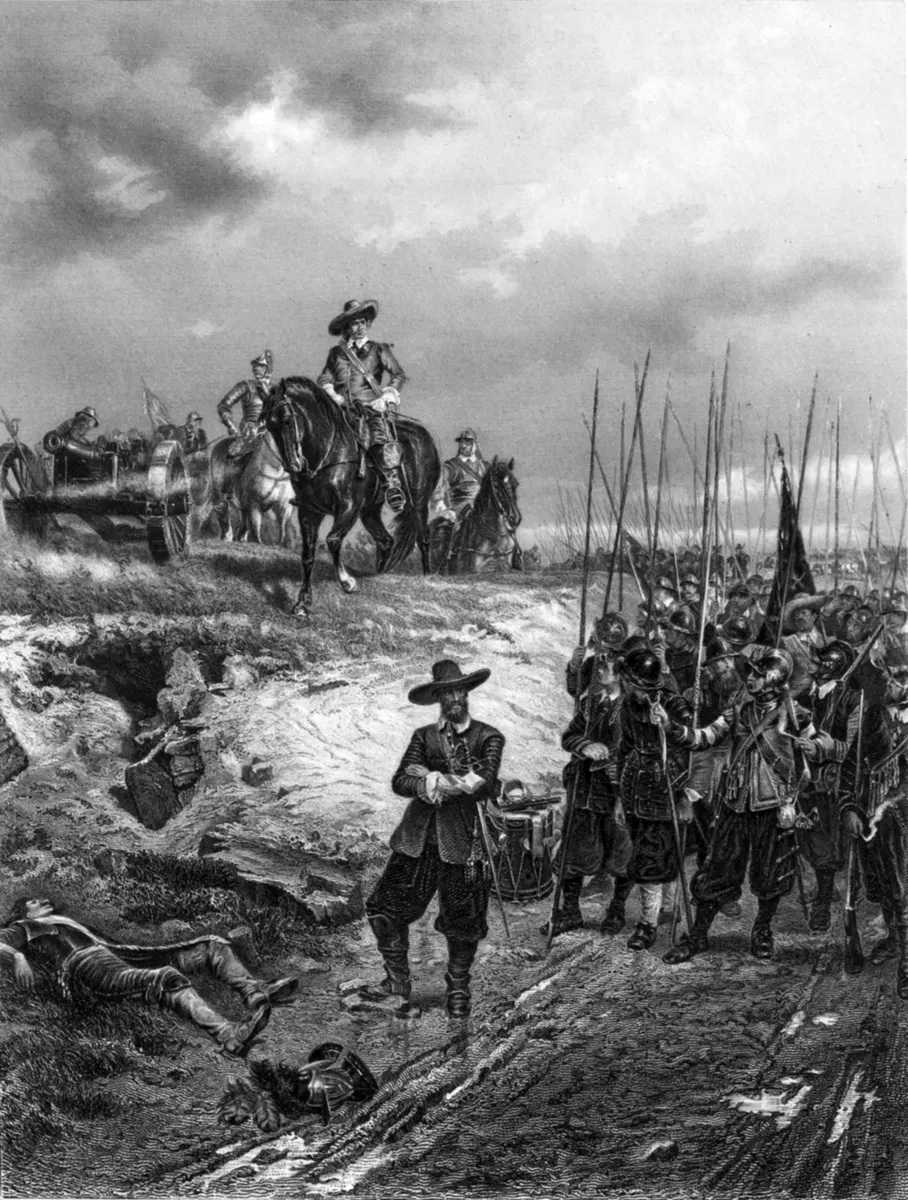
In October 1645, Sir William Vaughan made an attempt to relieve Chester. He marched by way of Denbigh in the hope of gathering further reinforcements. However the parliamentarians under the command of Colonel Thomas Mytton had gotten wind of Vaughan's plans and marched to intercept the royalists before they could reach Chester. Both armies met on the battlefield between the town of Denbigh and Whitchurch in which the royalists were eventually repulsed and forced back to the Denbigh Castle. The parliamentarians gave chase and where successful in capturing the lower town (often referred to as the 'Suburbs') of Denbigh.
In October 1645 Sir William Vaughan had gathered a considerable force consisting of 3000 men drawn from the garrisons of Ludlow and other citadels within the Marches. On his arrival at Denbigh he quartered his forces in the suburbs of the lower town, however this respite was short lived as word quickly arrived that Colonel Mytton was fast approaching at the head of a considerable force of 4000 men, with the sole intention of preventing the junction of Vaughan's forces with the besieged loyalists at Chester.
Sir William Vaughan immediately drew out his forces to give battle to the parliamentarians and the two armies clashed on the battlefield which was sited somewhere between the town and Whitchurch. For an hour some fierce fighting took place between both factions, however the royalists were eventually beaten back into the town of Denbigh. The parliamentarian infantry, which was chiefly composed of London “Reformadoes”, gave chase and soon got possession of the ‘Suburbs’ of the lower town.
Attempting to repel the parliamentarians, Vaughan ordered his cavalry to charge and he was able to put Colonel Mytton’s cavalry into disorderly retreat. However the battle soon became scattered in every direction of the lower town, in the streets, roads and the fields. Vaughan attempted in vain to rally and collect his disordered forces on Denbigh Green, his cavalry however were put to flight by the parliamentarians. Vaughan's infantry on the other hand successfully retreated into Denbigh castle, where they were hospitably received by the governor, Colonel William Salusbury. Salusbury who anticipating an attack upon the castle, had been anxiously watching all the movements of the two armies from atop one of the towers of the castle.
Sir William Vaughan’s cavalry were pursued by the parliamentarians as far as Llangerniew with their retreat being partially covered by royalist artillery. With Vaughan's cavalry in retreat and his remaining infantry sealed within Denbigh castle, the parliamentarians took possession of the suburbs. It is recorded the siege did not officially commence until the 17th April 1646, however the town and castle were virtually besieged, and the suburbs and environs occupied by the parliamentarians following Vaughan's defeat.