John Smalley moved to Greenfield from Lancashire and built the first cotton spinning mill in the Valley in 1777. John died in 1782 but the Cotton Twist Company carried on under the leadership of his mother and elder brother Christopher.
The cotton industry was booming and a second mill, Upper Mill, was built in just 6 weeks in 1783. Lower Cotton Mill followed in 1785, taking just 10 weeks to build the 6 storey building. Up to 300 apprentices were employed, many of them under 10 years old.
Christopher went into partnership with John Douglas of Manchester, renaming the company Messers Douglas and Smalley, and built Cresent Mill, the fourth mill in the Valley. It was also known as Yellow Mill because it was built with yellow stone from the Abbey.
They set up Holywell Bank around 1820 which also had a branch in Mold. By the 1830s over 1000 people were employed, of which about half were children. The Barracks was built to house the young female workers while many of the men slept in the mills.
Steam power was introduced in the mills by 1835 but the cotton industry slumped in 1837 and this, together with the Factory Act of 1833 which restricted the use of cheap labour, brought the business to an end. The bank collapsed in 1839 and the cotton mills closed in 1841.
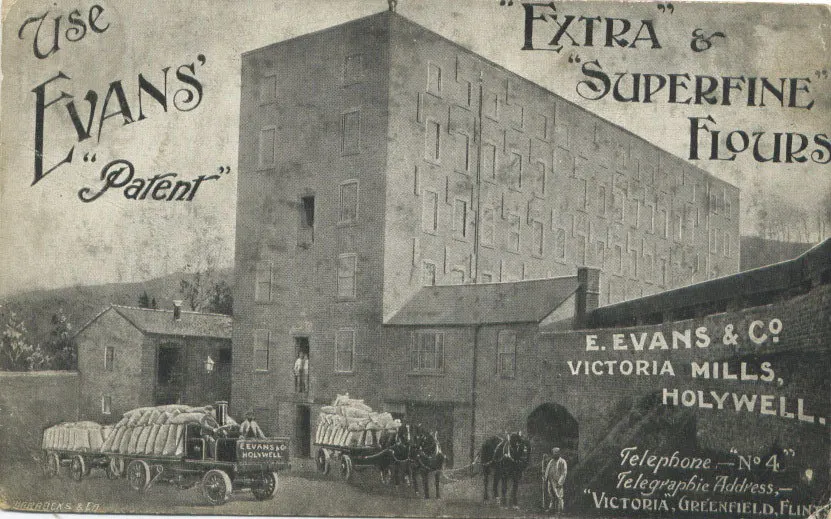
Lower Cotton Mill reopened as Evans Flour Mill in 1850, hence Flour Mill Pool. The building now houses a steam bottling plant.
In later years Yellow Mill was used for storage as the floors weren't strong enough to carry modern machinery.