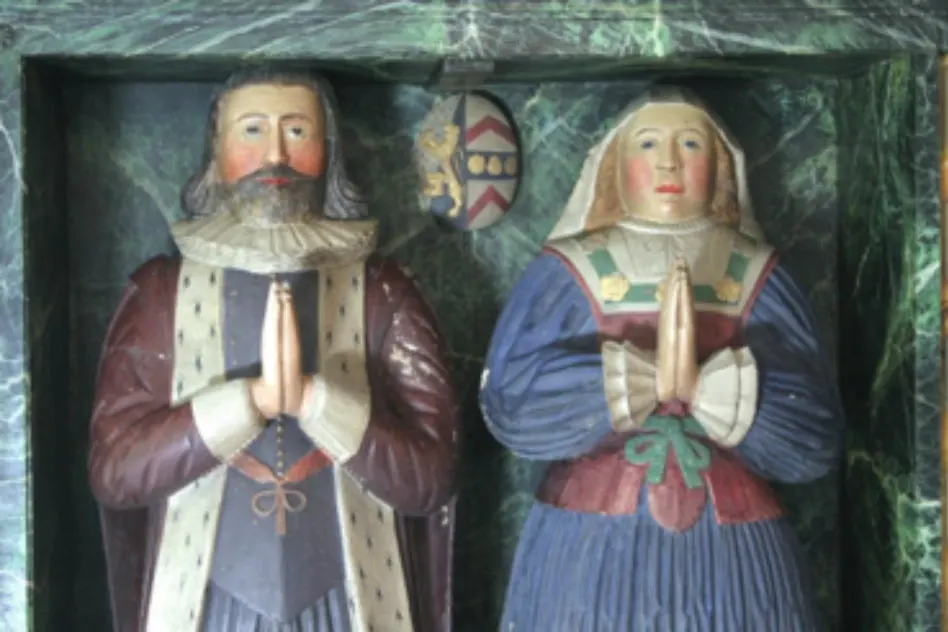
The Trevor Monuments
In the corner of the church by the new altar, you will find a Latin inscription to Sir John Trevor, with an effigy of Sir John and his wife to the right of the neighbouring window.
Conservation work was carried out on both these Tudor memorials in 2014, bringing to life much of their original colour and detail. It is tempting to think that the images provide a good likeness of the couple. The 23 coloured shields depicting the lineage of the Trevors with the Royal and Noble Tribes of Wales make the monument distinctive.
The Latin inscription records details of Sir John’s career and family; a little research will reveal that Sir John’s life was a little more complicated than described below!
Sacred to the memory of John Trevor Esquire, second son born to John Trevor of Trevallin in the County of Denbighshire. Gentleman Soldier, then Secretary to Charles Earl of Nottingham, Chief Admiral of the Invincible Fleet of England in 1588 when he recorded the deliverance of his country and triumph over the enemy. Supervisor of naval business under the monarchs Elizabeth and James, he was a noble individual and an esteemed servant of King James.
Married Margaret Hughes Trevanion, Lady of Cariheys in the county of Cornwall. Their surviving children were Joanna Trevor, first daughter and coheir who married Edmund Hampden, and Carolyn, daughter married first Charles Williams esquire of Langerbi Castle, then married Edward Fitton of Gawsworth, Baronet, in the County of Chester.
Trevor Roper WWI Memorials
Moving back down the south aisle you will see a brass plate to the memory of Charles Cadwalladar and Geoffrey Trevor Roper, lost within a few days of each other at Ypres in August 1917.
You will find their names among those on the Brass Memorial to those lost in WWI, whilst on the WWII memorial you will find the name of R D Trevor Roper who took part in the Dambusters raid and was killed later in the war
The Original Stone Church
Moving down the south aisle you enter the area of the original stone church which occupied more or less the middle third of this aisle and dates from the late 12th century. It was extended east in the 13th century and west in the 14th century. In this area you will see the font standing in front of a stained glass window.
The Font
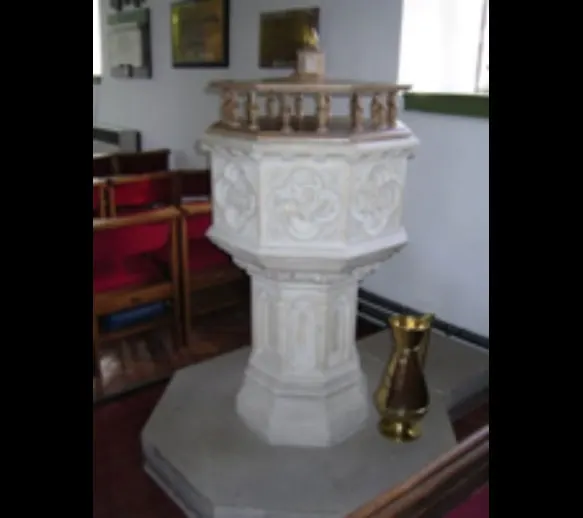
The font in place now is in Caen stone, costing £25 in 1867 and belongs to the first half of the 17th century. It was moved from the top of the west entrance steps to its current, much safer, position during the restoration in 2000.
The original medieval font is now in Llanfynyddd Church. It was given to Rectr Neville of Hawarden in 1820 who placed it in his garden. It was given to St Matthews Church, Buckley in 1902 and was returned to Hope only to be finally presented to Llanfynydd.
The 'O'Connor' Window
This window was installed in 1859 by friends and parishioners in memory of Rev. J.Vaughan Lloyd; the cost then was £30. It depicts Christ the King, with Moses holding the Ten Commandments, & Aaron with rod that budded.
It was originally installed behind where the organ now stands but was incorporated in the centre window of the south wall during the maintenance of the window in 2003.
Boer War Memorial
To the left of the organ is a small brass plate to the memory of Fusilier John Gallier who died 30th March 1901 in the Boer War.
The Organ
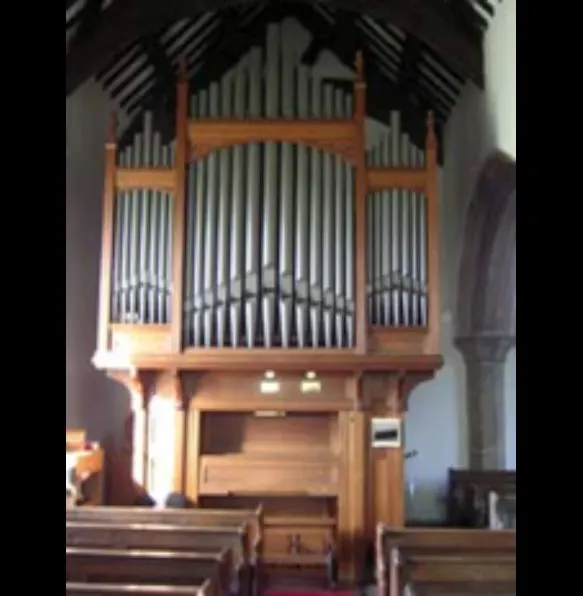
The nucleus of the organ originated from an old chamber organ given by Queen Caroline to the Atcherley’s of Cymau Hall. It was given by Miss Lucy Topping, sister-in law to David Francis Atcherley of Cymau Hall and was installed in a gallery at the west end of the church in 1852 when the old harmonium was sold for £4. It was moved to the east end of the south aisle in 1884, was rebuilt in 1905, enlarged in 1911 and as mentioned earlier was moved in 2000 to the west end of the south aisle due to subsidence into the crypt below.