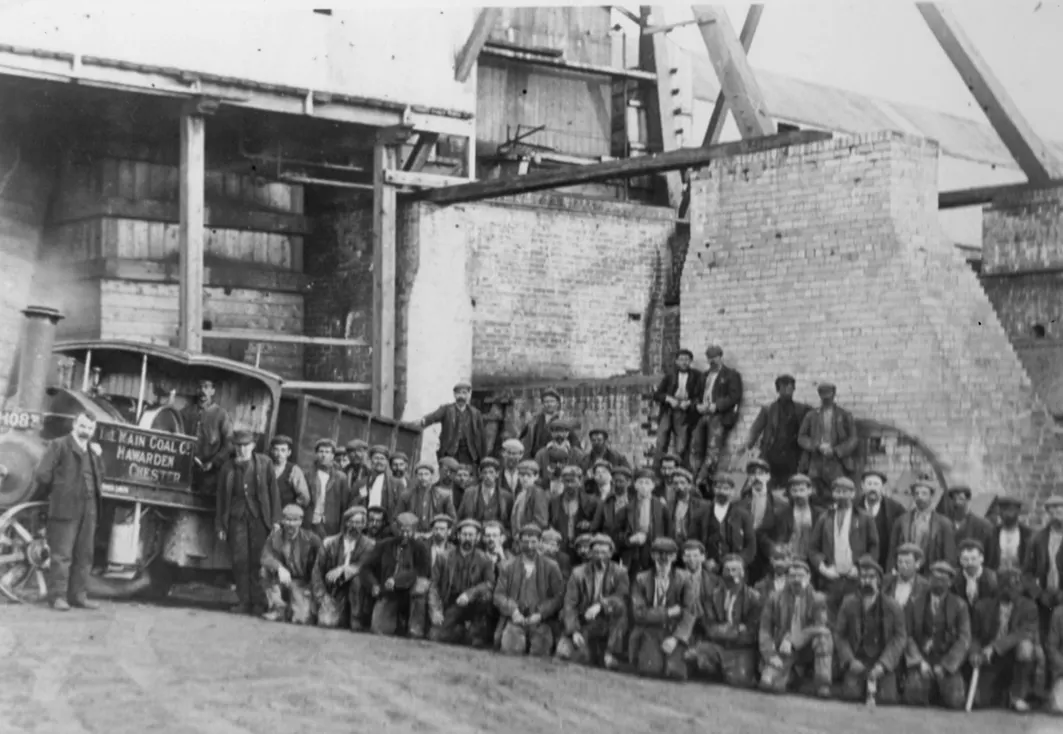
The Slutch
So called because of wet and muddy conditions, the mine was 145 feet deep situated on the junction of Kelsterton Lane and the B5126 opposite the entrance to Northop Hall Farm. It was among the pits worked by the Irish Coal Company known as ‘The Slutch’ (or Northop Hall), and when working the site for open cast coal after World War 11, tubs, shovels and bodies were dug out. There was also a pit in Plas Bellin fields.. A tramway ran to the main railway line.
The Galchog
The Galchog colliery in the field adjacent to the Cricket Field – 2 shafts, weighing machine and tramway. Known as Penny Venture, it closed in 1879.
Galchog Main
Started in 1879, located at the very edge of village road on the Northop end of the village. It was 140 feet deep with working hours of 7.00am to 4.30pm. The coal was taken down the village road to the railway at Dublin Main Colliery. This, in bad weather, caused dreadful road conditions. In the village school diary of 1901 it is recorded that parents refused to send children to school because the road was so bad. Galchog Main closed September 22nd 1914. The colliery buildings are still visible from the village road today.
Dublin Main Colliery
Located overlooking Chester Road. Two pits were sunk in 1873/4. Miners worked from 6am to 5pm weekdays and 6am to 1pm on Saturdays. Pay was poor and out of their wages miners were expected to pay for their own picks and powder. It closed in 1886 with many miners moving to work in collieries in Lancashire and Yorkshire.
The Elm Colliery
In the late 1860’s John Watkinson moved to the area from Halifax to start coal ventures. He bought Brook Park Farm now Northop Hall Hotel. In 1876 he sunk The Elm no1 pit. It was sunk to depth of 180 yds and was worked for 20 years. The best quality coal was sent to Holyhead for use on cross channel steamers. In 1894, The Elm no3 shaft was sunk and mining continued until 1934. In 1907, in his various mines, Mr Watkinson employed 778 men. John Watkinson was not just a good employer he was also a benefactor for the village. The Elm Colliery was situated on the Buckley Boundary across from Pinfold Lane
Open Cast Coal Mining
After WW2 mining took place on either side of Smithy Lane below the cricket field.
Rowley's Shaft
There were two shafts, roughly 30ft apart, both brick lined as they broke through the surface rock, roughly 8 -10 feet in diameter (so not that big) and well preserved. They had been backfilled with colliery waste (rock rubble mainly). These two shafts worked in tandem and were called an 'upcast' and a 'downcast', so men and materials/tools were lowered down one, the other used for the opposite reason and bringing coal to the surface.
Hopwood’s Drift
Hopwoods Drift is the colloquial name for the last coal mine to be established in the Northop Hall area. Its official name was Park Hill Colliery and was established by John Hopwood and his sons Thomas and Richard. During the months long 1926 Coal Strike, Castle Firebrick Co. Ltd. needed fuel for their kilns and had worked a seam of coal in ‘Foreign Parts’. The remains of this original mine can still be seen fenced off in a field between Robin Hood Lane and the Northop Hall Country House Hotel.
This was the site of the new venture but, because of the difficulties in extracting the coal, the Hopwoods set to work to lay out a drift three hundred yards south, close to Magazine Lane. During its peak, the mine yielded some 2,500 tons of coal per annum and provided employment for a workforce of ten.
In 1947 the Coal Industry was nationalised and as small as Park Hill Colliery was, it was included but handed back to the two brothers to be worked under licence and became one of the smallest NCB units in the country.
The mine operated until the 11th. November 1949, by which time most of the coal had been worked out.
One significant relic is the chimney stack in the small wood on Magazine Lane. It was the chimney for the steam raising boiler to pump out 200 gallons a minute of water from the workings into the nearby Ewloe Brook. The pump is still in situ having been abandoned down the mine when it closed and the stack is probably the last colliery chimney in the district.