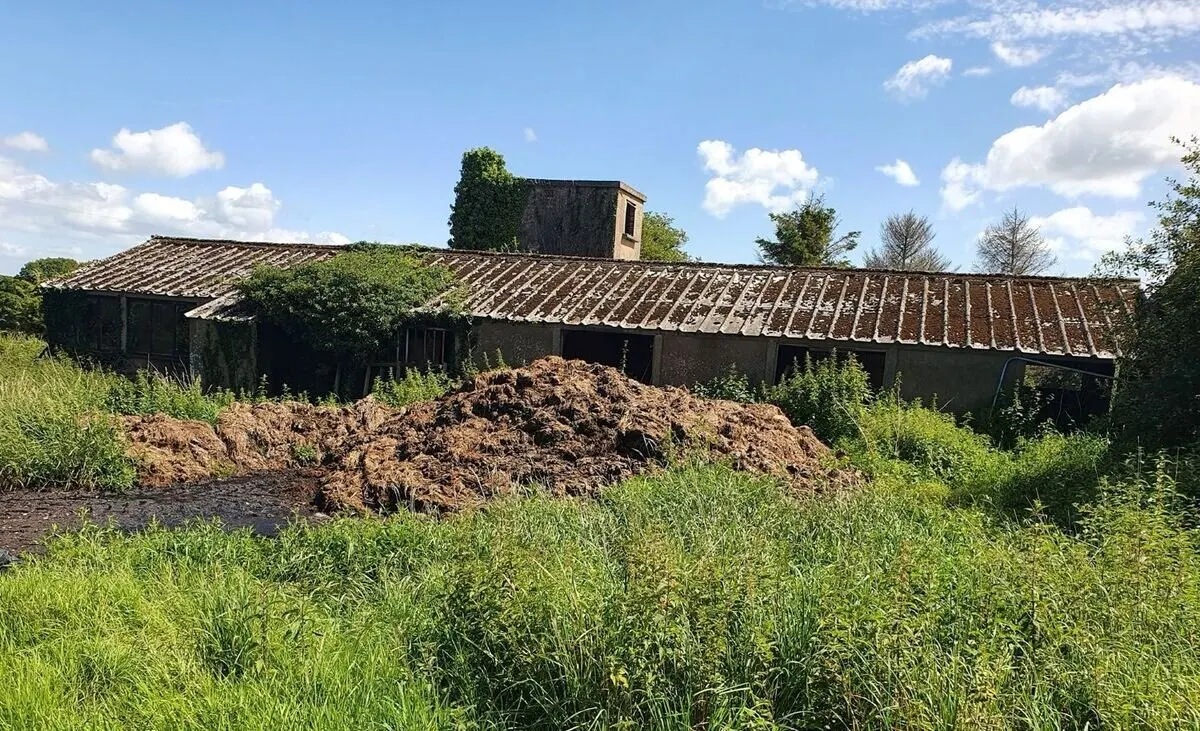
The photograph shows the final surviving building and last remaining physical evidence of what was once a Prisoner of War Camp at Cae Llys Farm, Northop Hall.
The camp is situated just off the Connahs Quay to Northop road and is adjacent to the junction with Bryn Gwyn Lane. The camp housed Italian POWs from 1944 till the end of WW2 and then housed German POWs following the war end till 1947. The camp was handed back to the Williams family of Cae Llys Farm in 1952 for the return to agricultural use. POWs worked on local farms and were engaged in public building works. The camp had a fairly relaxed regime and camp residents were able to frequent the local pubs in Northop Hall at times. The camp is an important part of village history. A number of POWs did not return to their homeland, instead they settled in the local area, married, raised families and became valued members of the community.
An extract from Vic Williams Booklet “We'll meet again Deeside 1937-1945” tell us - The first POWs to arrive were Italian and were accommodated at Cae Llys POW camp. Upon their arrival there were a number of local complaints. One was to Connahs Quay council that the prisoners had been seen playing football on a Sunday. Then, following the surveyors report to the Public Health meeting, great concern was expressed over the sewage disposal facilities at the camp. Here open latrines were feared to be contaminating the waters of the nearby Connahs Quay public reservoir. After an emergency meeting with the relevant Government officials the problem was solved. The POWs were not thought to be dangerous and therefore were not always confined to camp. For example, on Sundays they were marched down Mold Road To attend Connah's Quay Catholic Church and were used as labourers, preparing roads at Bryn Road and the Butler-Clough estate for post war public housing schemes.
There is also evidence that they were individually released from the camp for, in early December 1944 , there is an account of an Italian POW cycling down the Mold Road when, close to the steep junction with the high street , his brakes failed and , crossing the High Street at great speed, he crashed through the window of Mr Forber’s boot and shoe shop. Here he sustained serious injuries and was taken to a military hospital. The public were forbidden to enter these POW camps for, at Hawarden magistrates court, two local women were summonsed under the defence regulations. Here they had been arrested by the local Home Guard for consorting in the woods with Italian POWs. Now they were charged with two offences- “ conduct likely to prejudice discipline” and “entering without lawful authority”, a place where POWs were detained, both women were fined £2 each ( today approximately £64).
Immediately after the war the Italian POW's were repatriated and replaced at Cae Llys with German POWs. They were also used on local post war housing projects and allowed out of camp. Cynthia Lloyd (writing from Tasmania in 1994 ) lived at Wepre Hall cottage at the time and tells us that , “ after the war was over there were German POWs stationed up by Broad Oak Farm. They were given bikes and some of them found their way to Wepre Hall Cottage. Would you believe that the only person who wrote to us after the war was not one of the R.A.F at Wepre Hall but an ex German POW. Meanwhile post war Germany was devastated and near starvation. As such, during this period of 1945 to 1947 Rivertown Church, Shotton sent monthly gifts of food to the families of these POWs at Cae Llys - the parcels were almost entirely tins of meat or fish, evaporated milk and cartons of sugar - “ many letters of thanks were received from Germany from families of the POWs. The Germans left in 1947 and Cae Llys became a hostel for displaced persons (persons who had left their homeland through repression or fear). Mr Fleet, the Flintshire organiser gave details of the occupants - Russian Cossacks , Latvians, Ukranians, and a Finnish person whose father had been hanged by the Russians and two young men who had spent nine years in a concentration camp and were now uncertain of their nationality. They had all been terribly ill treated but were now responding to kindness. The camp provided a safe haven for many before its closure in 1952.