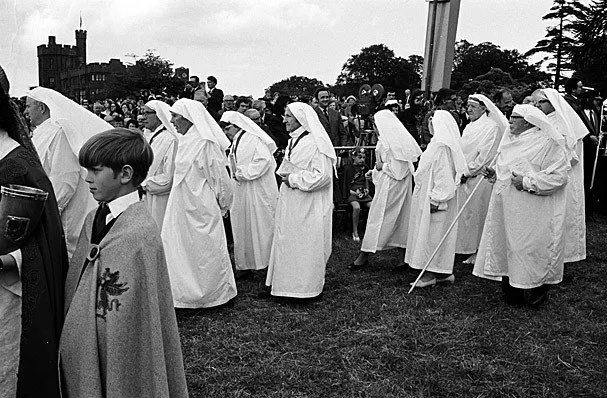
Gareth remembers taking part in the National Eisteddfod in Ruthin in 1973
The National Eisteddfod is the most important of several eisteddfodau held annually, mostly in Wales.
The National Museum of Wales says that the history of the Eisteddfod may be traced back to a bardic competition, held by Lord Rhys, in Cardigan Castle in 1176, but the National Eisteddfod of Wales, as an organisation, traces its history back to the first event held in 1861, in Aberdare.
With eight days of competitions and performances it is considered to be the largest music and poetry festival in Europe.
The National Eisteddfod is traditionally held in the first week of August, and the competitions are all held in the Welsh language.
The Festival has a quasi-druid flavour, with the main literary prizes for poetry and prose being awarded in colourful and dramatic ceremonies, under the auspices of the Gorsedd of Bards, complete with prominent figures in Welsh cultural life, dressed in flowing druidic costumes, flower dances, trumpet fanfares, and a symbolic Horn of Plenty.
The Eisteddfod moves between locations in North and South Wales on an annual basis, with hundreds of tents, pavilions and booths being erected in an open space to form the ‘Maes’ (Field).